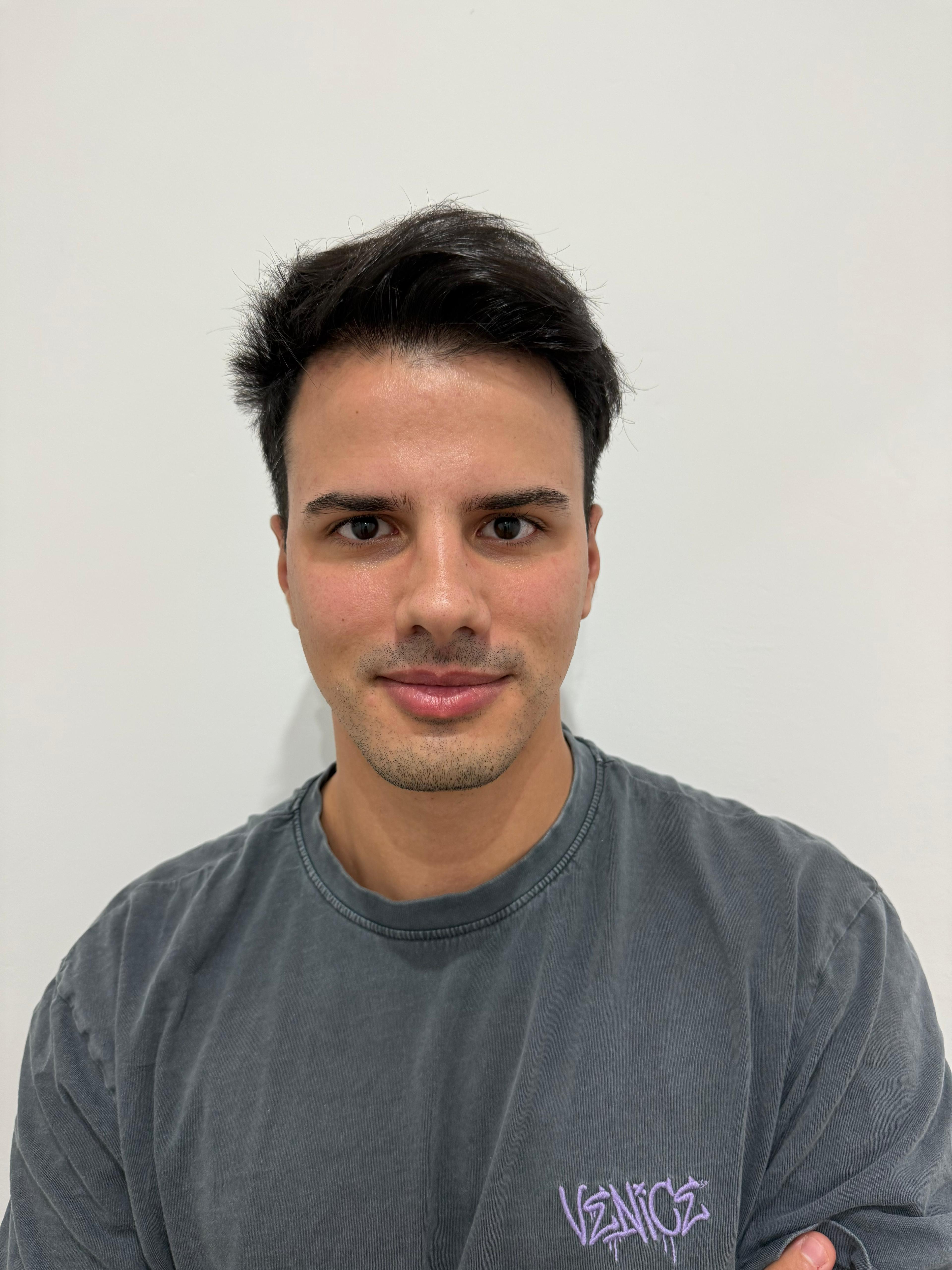
Johnny Núñez Cano
I’m an AI Developer Advocate at NVIDIA working at the intersection of Physical AI, Robotics, and Edge Computing. I build and teach end-to-end workflows spanning simulation, foundation models, teleoperation, and real-time deployment on edge hardware — from Isaac Sim and GR00T to Jetson Thor and DGX Spark.
I’m co-organizing “The Full Stack of Physical AI” tutorial at CVPR 2026 in Denver, covering simulation, foundation models, and edge deployment for next-generation robotics. I’m also pursuing a PhD in Computer Vision at the University of Barcelona with the HuPBA group, researching Human-Robot-Object Interactions (HROIs) at the intersection of generative AI, robotics, psychology, and neuroscience.
What I Do at NVIDIA
- Physical AI & Robotics Workflows — Design, build, and teach end-to-end pipelines using Isaac Sim, Isaac Lab, Genesis, GR00T, NemoClaw, OpenShell, and ROS/ROS 2 for simulation, teleoperation, synthetic data generation, and policy deployment on real robots.
- Edge-to-Cloud AI Architectures — Develop scalable robotics AI systems integrating Jetson edge inference (Orin, Thor) with cloud-native microservices for distributed compute, fleet management, and CI/CD.
- High-Performance Inference — Deploy, accelerate, and benchmark LLMs, VLMs, and VLAs using TensorRT-LLM, vLLM, SGLang, and FlashInfer on platforms from Jetson to DGX and Blackwell (GB300).
- Open-Source & Community — Lead hackathons, deliver workshops, and contribute to projects like jetson-containers, vLLM, flash-attention, Isaac-GR00T, and ONNX Runtime.
- Applied Research — Prototype social cognition and social behavior in robotics, enabling robots to understand human intent and cooperate naturally in shared environments.
Highlighted Work
- CVPR 2026 Tutorial: The Full Stack of Physical AI — Co-organizing a half-day tutorial on simulation, foundation models, and edge deployment for robotics at CVPR 2026 in Denver, CO.
- Unblocking next-gen hardware for the AI community — Contributed critical patches to Flash Attention, vLLM, SGLang, PyTorch, Mamba, xformers, and more to enable Jetson Thor, DGX Spark, and GB300 support — making the entire Blackwell inference ecosystem usable for developers worldwide.
- Deploying VLMs on Jetson — Co-authored the official Hugging Face tutorial (35+ upvotes) on deploying Cosmos Reason 2B across Jetson Thor, AGX Orin, and Orin Super Nano with vLLM and Live VLM WebUI.
- Cosmos Reasoning 2B on Jetson — Blog and deployment guide for Cosmos Reasoning on Thor/Orin/Nano.
- Ported Isaac Sim, Isaac Lab, and Newton physics engine to jetson-containers for Thor/Spark/GB300.
- DGX Spark Playbook — Authored the official DGX Spark playbook for robotics simulation and training.
- Distributed inference on Jetson Thor — First to run distributed vLLM and SGLang on Jetson Thor.
- decord2 — Efficient video loader with FFMPEG 8 + CUDA 13.2 + aarch64/SBSA; adopted in NVIDIA Isaac-GR00T.
- edge2cloud — ML containers for NVIDIA CUDA SBSA (Jetson → DGX Spark → cloud).
- The Fused Kernel Library — Co-authored FKL, a C++ API for highly-efficient fused GPU kernels.
- NeurIPS 2025 Demo — Hardware-in-the-loop robotics demonstration.
- DGX Spark + Jetson Thor Mini Rack — Custom compact AI infrastructure for distributed edge + compute workloads.
Open-Source Contributions
With 314+ public repositories and 371+ GitHub followers, I’ve made concrete, merged contributions to the core AI infrastructure stack. Here are selected PRs:
Enabling next-gen NVIDIA hardware across the open-source AI stack:
| Repository | PR | What |
|---|---|---|
| Dao-AILab/flash-attention | #1904 | CUDA 13 + sm12x support |
| Dao-AILab/flash-attention | #2222 | Hybrid Flash Attention |
| vllm-project/flash-attention | #95 | CUDA 13 for vLLM FA |
| sgl-project/sglang | #11299 | Enable Thor/Spark/GB300 |
| sgl-project/sgl-flash-attn | #8 | SGLang Flash Attention CUDA 13 |
| pytorch/pytorch | #165048 | Fix CUDSS for Thor/Spark |
| facebookresearch/xformers | #1344 | Blackwell support |
| state-spaces/mamba | #776 | Mamba CUDA 13 (hybrid attention) |
| bitsandbytes-foundation/bitsandbytes | #1491 | Blackwell binaries |
| opencv/opencv | #27537 | Refactor Blackwell |
| kvcache-ai/Mooncake | #344 | Enable SBSA |
| fzyzcjy/torch_memory_saver | #16 | Fix for SGLang |
Robotics & Edge AI:
| Repository | PR | What |
|---|---|---|
| NVIDIA-AI-IOT/jetson-containers | #258 | Isaac Sim, Isaac Lab, Newton, Warp, CuPy, Numba |
| NVIDIA-AI-IOT/jetson-containers | #240 | Jetson Thor GR00T + LeRobot |
| NVIDIA-AI-IOT/jetson-containers | #230 | Container fixes |
| dusty-nv/jetson-containers | #1391 | SGLang, vLLM, TF, Triton Blackwell |
| NVIDIA/Isaac-GR00T | #212 | decord2 integration |
| NVIDIA-AI-IOT/jetson-ai-lab | #343 | Cosmos Reasoning 2B blog |
| rbonghi/jetson_stats | #718 | Fix jtop for Thor/Spark |
| dusty-nv/jetson-inference | #1942 | NumPy 2.0 + Python 3.12 |
| odincodeshen/arm-learning-paths | #1, #2 | ARM demo community |
Industry Impact
My open-source contributions to enabling the Grace/Hopper (GH200) and Grace/Blackwell architectures across the AI software stack have had direct, measurable business impact. By making these platforms easier to use for the developer community, I’ve helped major cloud GPU providers fully sell out their GH200 capacity and accelerate their path toward GB200 and beyond. When the software ecosystem works seamlessly, hardware adoption follows.
Research & Publications
My research spans human-robot-object interactions, non-verbal behavior forecasting, social cognition in robotics, and efficient GPU computing. Published at WACV, PMLR, and arXiv, with collaborators including Sergio Escalera, Isabelle Guyon, and Cristina Palmero.
See all publications on my Google Scholar profile.
Background
I hold a Master’s in Computer Vision from Universitat Autònoma de Barcelona (UAB) / Computer Vision Center, a Master’s in Data Science from UB, and a B.S. in Computer Engineering from UB. Before joining NVIDIA, I worked as a deep learning developer at Fundació Bosch i Gimpera on multi-object detection and Edge AI optimization, and as a research engineer at Milestone Systems on loitering detection for Smart Cities. I’m proficient in C/C++, CUDA, Python, ROS/ROS 2, Docker, Kubernetes, and the full NVIDIA AI stack.
Career Origin
At 16, I tore my ACL, ending my path toward professional football in Spain’s second division. That injury became a turning point — I found refuge in AI when tools like Theano were the only option. Over time, I developed a deep passion for neuroscience, psychology, humanoids, and robots. Attending GTC 2024 in San José was a defining moment — surrounded by people who shared my passion, I told myself, “One day, I’ll work here.” Now I’m building the future of Physical AI at NVIDIA.
Contact
- Work: jnunez@nvidia.com
- Academic: johnnynunez@ub.edu
- GitHub issues for project questions; LinkedIn DMs for collaborations.